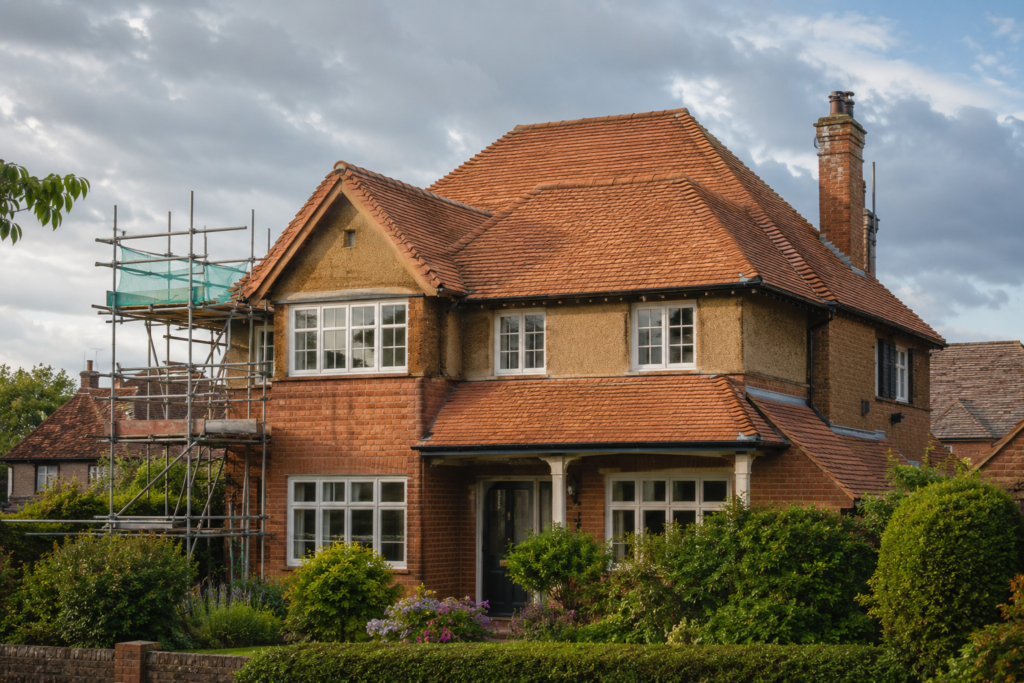
In 2026, replacing the roof on a detached house in the UK typically costs between £8,000 and £20,000+. A standard 3-bed detached house with a gable roof averages £8,000–£12,000, while a complex 4-bed hipped roof in natural slate can comfortably exceed £20,000.
Detached house roof replacement cost is consistently higher than for terraced or semi-detached properties — and there are three main reasons for that. First, detached homes have a larger roof surface area. Second, they often feature more complex shapes: hipped ends, valleys, dormers, and chimneys all add labour time. Third, scaffolding must go up on all four sides of the building, which is a significant extra cost compared to a mid-terrace where two walls are shared. Understanding these factors upfront helps you budget accurately and avoid nasty surprises.
Key Takeaways
- Typical cost range: £8,000–£20,000+ for a full detached house roof replacement in 2026, depending on size and complexity [1]
- Labour accounts for 50–60% of the total bill, so don’t focus only on material prices [2]
- Scaffolding on all four sides costs £1,500–£3,000+ for a detached home — more than for a semi or terrace
- Natural slate lasts 100+ years but costs £120–£200+ per m²; concrete tiles are the budget-friendly option at £45–£65 per m²
- Regional pricing varies: London and the South East run 20–30% above the national average [5]
- Building Regulations (Part L) apply if you’re replacing more than 25% of your roof — insulation upgrades may be required
- Repair vs. replacement: If your roof is under 20 years old and leaks are isolated, repair is almost always cheaper — see the Roof Repair vs. Replacement guide for a full breakdown
- Hidden costs — timber repairs, waste removal, and new fascias — can add £2,000–£4,000 to the base quote
- Government grants for roofing alone are rare, but ECO4 may help if insulation is included
How Much Does a New Roof Cost for a Typical 3-Bedroom Detached House?
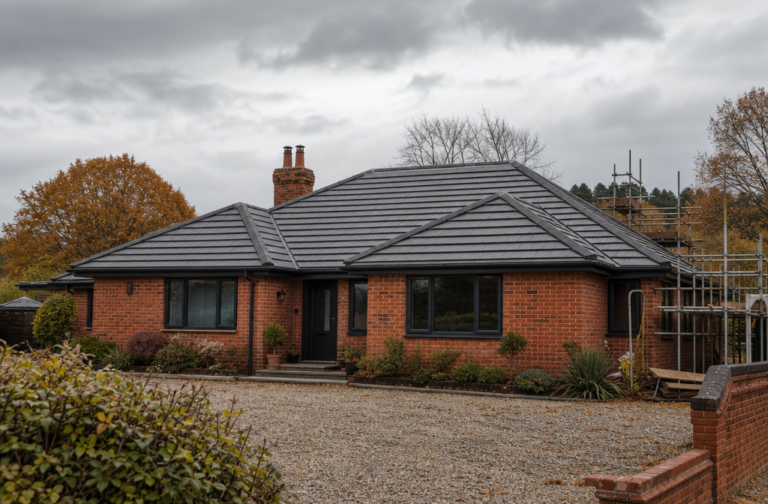
For a standard 3-bedroom detached house with a gable or hipped roof, expect to pay between £9,000 and £14,000 for a full replacement using concrete or clay tiles, including labour and materials [1]. Complex roof shapes, premium materials, or significant timber repairs push this higher.
The table below gives a reliable pricing matrix based on house size and roof geometry:
| House Size & Roof Shape | Average Roof Area | Estimated Cost (inc. Labour & Materials) |
|---|---|---|
| Small Detached (Gable) | 70–90 m² | £7,000–£10,000 |
| 3-Bed Detached (Hipped) | 90–110 m² | £9,000–£14,000 |
| 4-Bed Detached (Complex/Valleys) | 110–140 m² | £14,000–£18,000 |
| Large Period/Heritage Detached | 150+ m² | £18,000–£25,000+ |
Decision rule: If your detached house has a simple gable roof and you’re happy with concrete tiles, you’re at the lower end of these ranges. Add a hipped design, natural slate, or a property built before 1930 and the cost climbs quickly.
For a quick personalised estimate, try the Roof Replacement Cost Calculator.
Detached House Roof Replacement Cost Estimator
Loading calculator...
How We Calculate Our Prices
Our pricing algorithm combines data from multiple UK trade sources to provide accurate, up-to-date estimates. We cross-reference material costs from national suppliers, labour rates from regional trade bodies, and completed project data from verified UK roofing contractors.
- Material costs are benchmarked against current supplier pricing from major UK distributors (updated quarterly)
- Labour rates reflect 2026 NFRC and FMB recommended rates adjusted by region
- Regional modifiers account for cost-of-living variations across UK postcodes
- Project factors include scaffolding, waste removal, and building regulations where applicable
Estimates are for guidance only and do not constitute a formal quotation. Final costs depend on a professional site survey. Prices last reviewed: July 2026.
What Are Average Roof Replacement Prices in Different UK Regions?
Labour rates vary significantly across the UK, and where you live can shift your final quote by thousands of pounds [5].
- London & South East: Expect to pay 20–30% above the national average. Higher labour rates, ULEZ charges for tradesmen’s vans, and parking costs all contribute [5]
- Midlands & East of England: Generally close to the national average
- North of England (Manchester, Leeds, Yorkshire): Slightly below average in many areas — competitive market with strong supply of qualified roofers
- Scotland & Wales: Variable; rural areas can be higher due to travel costs and limited local contractors
- Northern Ireland: Typically lower than the England average
For city-specific estimates, the Birmingham roof cost calculator, Manchester roof cost calculator, and London roof cost calculator give localised figures instantly.
Is It Cheaper to Repair or Completely Replace My Roof?
Repair is almost always cheaper in the short term, but replacement often works out better value if your roof is over 40–50 years old or has widespread problems. A targeted repair costs £150–£1,500 depending on the issue, while a full replacement runs £8,000–£20,000+ [4].
Choose repair if:
- The roof is under 20–25 years old
- Damage is isolated (a few broken tiles, a single leak point)
- The underlying structure and felt are in good condition
Choose replacement if:
- The roof is over 50–60 years old with no felt underlay
- You have multiple leak points or a sagging roofline
- Repair costs are stacking up year after year
The Roof Repair vs. Replacement: 2026 UK Cost & Decision Guide covers this decision in full detail.
What Factors Make Roof Replacement More Expensive?
Several variables push detached house roof replacement cost above the baseline estimate [4] [6].
Roof complexity: Hips, valleys, dormers, and chimneys can add 15–30% to the total cost due to extra cutting, flashing, and labour time [4].
Roof size: Larger roofs simply need more materials and more days on site [6].
Material choice: Natural slate costs roughly 3–4 times more per m² than basic concrete tiles.
Structural condition: Rotten battens or damaged rafters discovered once the old tiles come off can add £500–£1,500 in unplanned timber repairs [4].
Access and location: Steep pitches, restricted access, or a city-centre location all increase scaffolding and labour costs.
Waste removal: Skip hire and disposal of old roofing materials typically adds £900–£1,500 to the bill.
How Much Do Roofing Materials Cost? (Price Per m²)
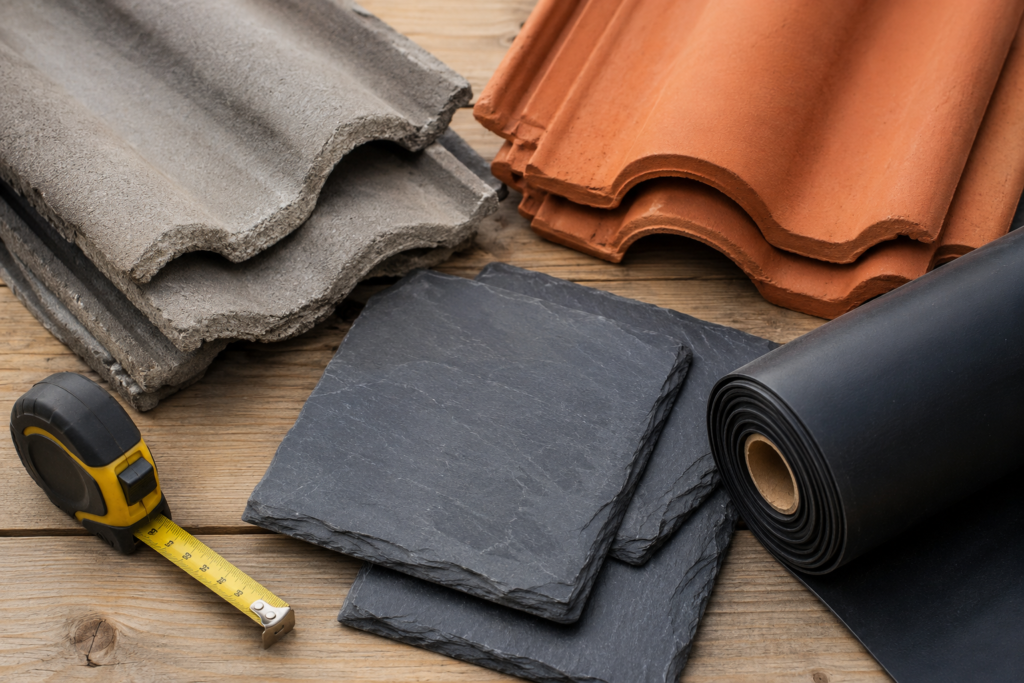
Material costs vary widely. Labour accounts for 50–60% of the total bill [2], but your material choice still has a big impact on the final figure — and on how long before you need to do this again.
Concrete Tiles — The Budget Choice (£45–£65 per m²)
Concrete tiles are the most common choice for modern UK detached homes. They’re heavy but cost-effective, and a well-laid concrete tile roof lasts 30–50 years. For a 100 m² roof, materials alone run roughly £4,500–£6,500. Use the Tile Roof Cost Calculator for a full estimate.
Clay Tiles — The Traditional Look (£80–£150 per m²)
Clay tiles suit older detached homes and conservation areas well. They’re 20–30% more expensive than concrete but offer greater longevity and a more authentic appearance [2]. A good clay tile roof can last 60–100 years with proper maintenance.
Natural Slate — Premium & Heritage (£120–£200+ per m²)
Natural slate is the premium option [3]. It’s the most expensive material upfront but lasts 100+ years, making it cost-effective over a very long timeframe. Welsh or Spanish slate are the most common sources in the UK. For a detailed breakdown, see the Slate Roof Cost Calculator.
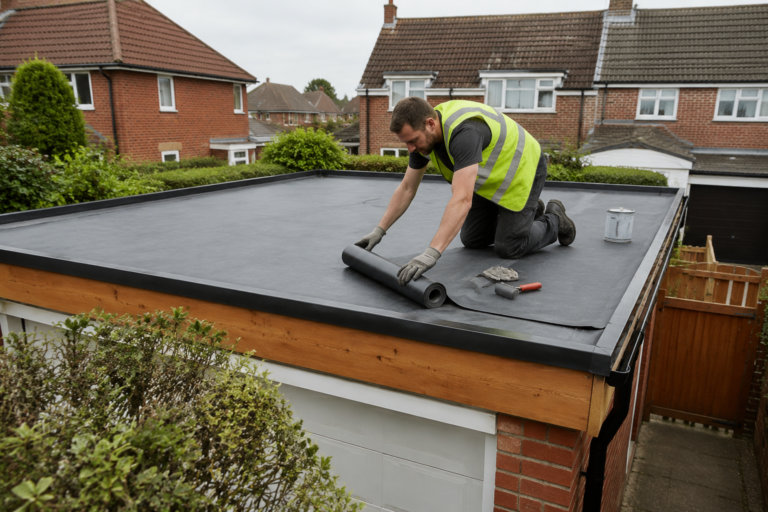
Flat Roof Extensions — EPDM/GRP (£50–£100 per m²)
Many detached homes have a flat-roofed garage or rear extension. EPDM rubber roofing costs £1,500–£3,500 for a 25 m² flat roof, while GRP (fibreglass) runs £2,200–£4,500 for the same area [4]. See the Flat Roof Cost Calculator for more.
The Hidden Costs: Labour, Scaffolding, and Waste
Materials are only part of the story. Labour accounts for 50–60% of the total detached house roof replacement cost [2], and several additional expenses catch homeowners off guard.
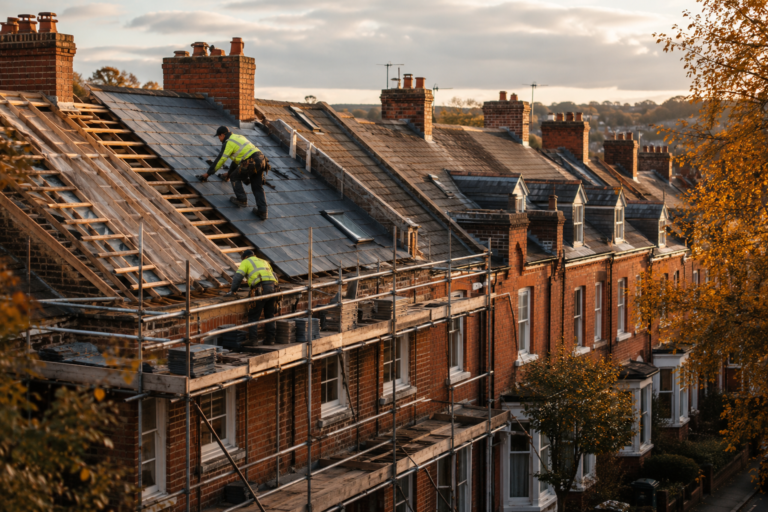
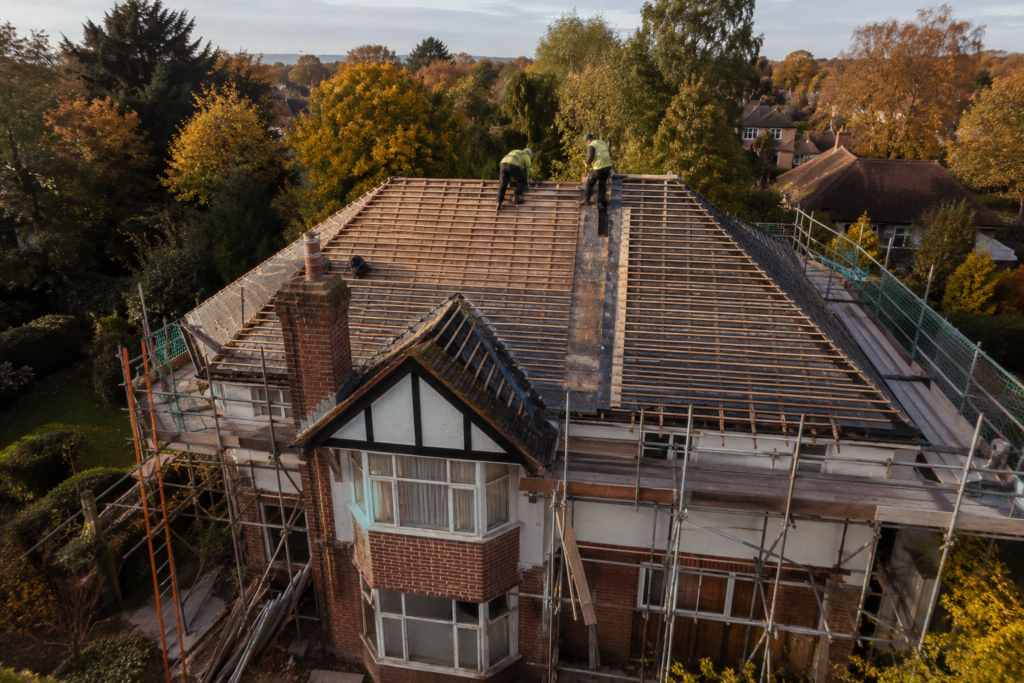
Wrap-around scaffolding: Because a detached house has no shared walls, scaffolding must go up on all four sides. This costs £1,500–£3,000+ depending on the roof height and property size — significantly more than for a semi-detached or terraced home [4].
Labour rates: UK roofers typically charge £200–£300 per day per person. A team of two to three roofers will spend one to three weeks on a full detached roof replacement [2].
Waste removal: Disposing of the old roof covering, felt, and battens typically costs £900–£1,500 via skip hire.
Timber repairs: Once the old tiles come off, rotten battens or damaged rafters sometimes appear. Budget an extra £500–£1,500 as a contingency for structural timber work [4].
Fascias, soffits, and guttering: Many homeowners replace these at the same time. Replacing uPVC fascias, soffits, and gutters on a typical detached house costs £1,500–£4,000 [7].
North vs South: Regional Price Variations in the UK
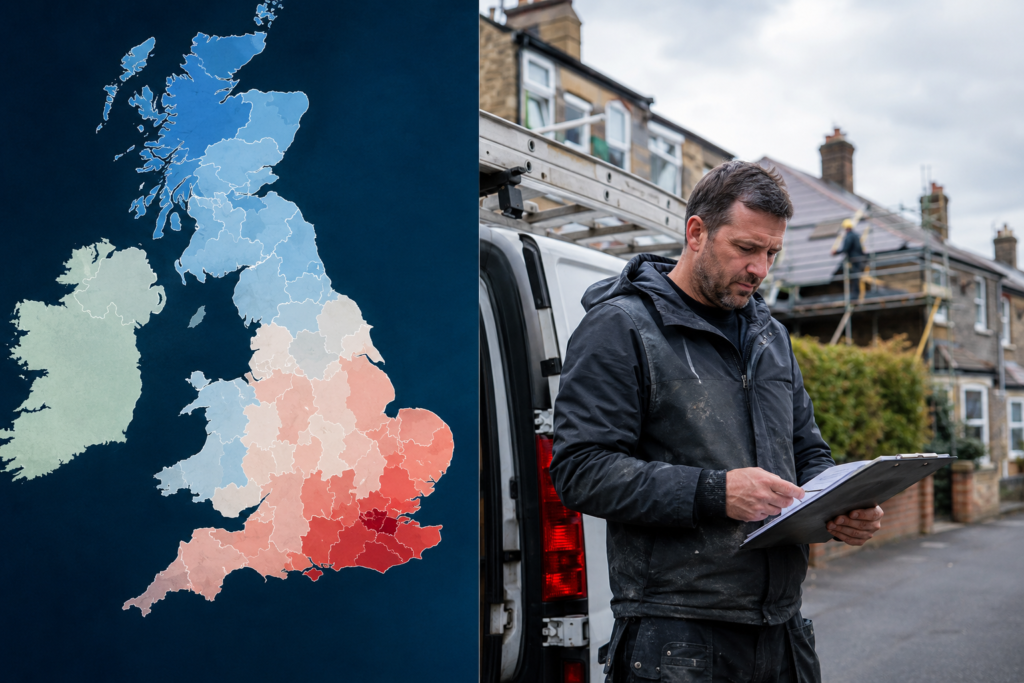
Geography has a real impact on what you’ll pay. Labour rates in London and the South East are often 20–30% higher than in the North or parts of Wales [5].
- London & South East: Premium pricing. A job quoted at £12,000 in Manchester could cost £15,000–£16,000 in London once ULEZ charges, parking permits, and higher day rates are factored in
- Midlands: Close to the national average; Birmingham is a competitive market with good contractor availability
- North of England: Leeds, Manchester, and Sheffield tend to offer competitive rates — often 5–10% below the national average
- Scotland: Glasgow and Edinburgh are broadly comparable to the Midlands; rural Highland properties can be higher
- Wales: Rural areas can attract a premium due to limited contractor availability; urban South Wales is more competitive
Do I Need Building Regulations or Planning Permission?
Building Regulations apply in England and Wales if you’re replacing more than 25% of your roof. Under Part L (conservation of fuel and power), you’ll need to upgrade the roof’s thermal insulation at the same time. Your roofer should be aware of this, but it’s worth confirming before work starts.
Planning permission is generally not required for a like-for-like roof replacement on a standard detached house. Exceptions include:
- Listed buildings (always check with your local planning authority)
- Properties in a conservation area where the new materials would alter the appearance
- Any alteration that changes the height or shape of the roof
If in doubt, a quick call to your local council’s planning department is free and takes minutes.
What Signs Indicate You Definitely Need a Full Roof Replacement?
Some roof problems can be patched; others are a clear sign the whole structure needs replacing. Here’s a quick diagnostic checklist:
- ☑ Daylight visible through the loft — gaps in the roof deck mean the structure has failed
- ☑ Sagging roofline — indicates structural timber failure, not just a surface problem
- ☑ Persistent leaks despite multiple repairs — if you’ve patched the same area twice or more, the underlying felt or structure is compromised
- ☑ Roof age over 60 years with no felt underlay — pre-1960s roofs were often laid without felt; once tiles start failing, replacement is more cost-effective than ongoing repair
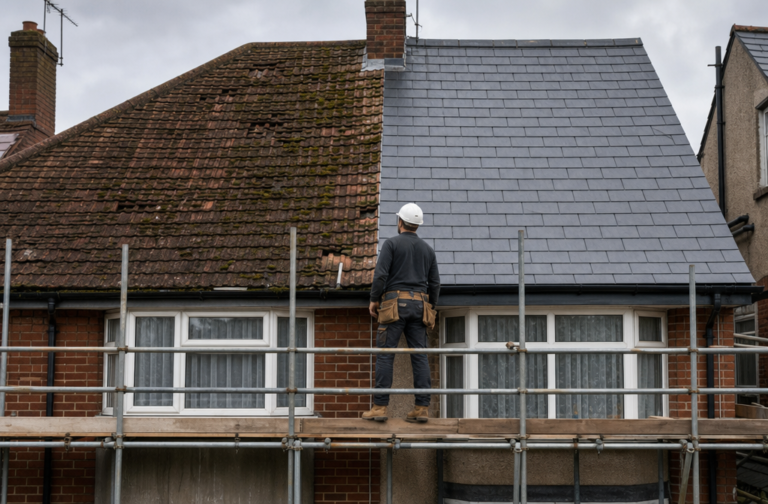
- ☑ Large-scale moss or algae growth — surface moss is manageable, but heavy growth across the whole roof often signals deteriorating tiles
- ☑ Multiple cracked, slipped, or missing tiles — isolated damage is repairable, but widespread failure across the whole surface points to end-of-life materials
Case Study: Replacing a 1930s Hipped Roof in Birmingham
Property: 4-bedroom 1930s detached house, hipped roof with two chimneys and a rear dormer.
Location: Edgbaston, Birmingham.
Roof area: Approximately 125 m².
Material chosen: Reclaimed clay tiles to match the original character of the property.
Scaffolding: Full 360-degree wrap required due to detached position and sloped rear garden.
Cost breakdown:
| Item | Cost |
|---|---|
| Clay tiles (materials) | £5,200 |
| Labour (3 roofers, 9 days) | £5,400 |
| Scaffolding (3 weeks) | £2,200 |
| Timber repairs (two rafters, battens) | £1,100 |
| Waste removal | £600 |
| Total | £14,500 |
Time taken: 9 working days (plus 2 days for scaffolding erection and removal).
Key lesson: The homeowner received three quotes ranging from £11,800 to £16,200. The middle quote (£14,500) came from a contractor who spotted the rotten rafters during the survey and included a contingency — the cheapest quote did not, and would likely have resulted in additional invoices mid-job.
Frequently Asked Questions
Is £20,000 too much for a new roof on a 4-bed detached house?
Not necessarily. If your house has a complex hipped roof with valleys, requires full 360-degree scaffolding, and you’re using premium materials like natural slate or need extensive timber repairs, quotes of £20,000–£25,000 are increasingly common in 2026 [1] [4].
How long does a roof replacement typically take?
For a standard detached house, a full roof replacement typically takes between one and two weeks. Complex designs, bad weather, or significant structural repairs can extend this to three weeks [4].
Can I do a roof replacement myself or do I need professionals?
Roof replacement on a full detached house is not a DIY job for most homeowners. Working at height carries serious safety risks, and incorrect installation can void material warranties and cause costly water damage. Always use a qualified, insured roofer — ideally one registered with the NFRC (National Federation of Roofing Contractors).
What type of roofing material is most cost-effective in the UK?
Concrete tiles offer the best balance of upfront cost and lifespan for most UK detached homes, at £45–£65 per m² [2]. Clay tiles cost more but last longer. Natural slate has the highest upfront cost but the longest lifespan (100+ years), making it cost-effective for heritage properties where you plan to stay long-term [3].
Will my home insurance cover roof replacement?
Home insurance typically covers sudden, accidental damage (such as storm damage or a fallen tree). It does not usually cover gradual wear and tear or age-related deterioration, which is the most common reason for a full roof replacement. Always check your policy wording and speak to your insurer before assuming cover applies.
Are there government grants or tax credits for roof upgrades?
Direct grants purely for roofing are rare. However, the ECO4 scheme (Energy Company Obligation) may contribute if the roof replacement is combined with significant insulation upgrades, and you meet the income or energy-efficiency criteria. The Great British Insulation Scheme is also worth investigating. Contact your energy supplier or local council for eligibility checks.
What additional costs should I budget for beyond basic roof replacement?
Beyond materials and labour, budget for: scaffolding (£1,500–£3,000+), waste removal (£900–£1,500), timber repairs (£500–£1,500 contingency), and fascias/soffits/guttering if replacing at the same time (£1,500–£4,000) [7] [4].
How do slate roofs compare to tile roofs in terms of cost?
Natural slate costs roughly £120–£200+ per m² installed, compared to £45–£65 per m² for concrete tiles [2] [3]. Slate costs 2–4 times more upfront but lasts significantly longer. For a 100 m² detached roof, that’s roughly £5,000–£6,500 for concrete tiles vs. £12,000–£20,000+ for natural slate in materials alone.
Conclusion
Replacing the roof on a detached house is one of the largest single home improvement investments you’ll make. In 2026, budgeting £9,000–£14,000 for a standard 3-bed detached home is realistic, with larger or more complex properties running to £18,000–£25,000+. The key variables are roof size, shape, material choice, regional labour rates, and the condition of the underlying timber structure.
Actionable next steps:
- Get at least three written quotes from NFRC-registered roofers — and make sure each quote includes a contingency for timber repairs
- Use a cost calculator to set a realistic budget before any contractor visits: Roof Replacement Cost Calculator
- Check Building Regulations — confirm with your roofer that the job will comply with Part L insulation requirements
- Review your home insurance policy before work starts to understand what (if anything) is covered
- Don’t choose on price alone — the cheapest quote often excludes hidden costs that appear mid-job
If you’re comparing house types, the 3-bed semi-detached roof cost guide and terraced house roof replacement cost guide are useful benchmarks.
References
[1] Roof Replacement Cost By House Type UK – https://ddkroofingleedsltd.co.uk/roof-replacement-cost-by-house-type-uk/?utm_source=openai
[2] UK Roofing Costs Price Guide – https://www.roofersaround.co.uk/article/uk-roofing-costs-price-guide?utm_source=openai
[3] Roof Replacement Cost UK Guide – https://housejester.com/blog/roof-replacement-cost-uk-guide?utm_source=openai
[4] Roof Replacement Cost UK – https://www.bestbuilders.co.uk/costs/roof-replacement-cost-uk?utm_source=openai
[5] Roof Replacement Cost UK 2026 – https://www.bookabuilderuk.com/blog/roof-replacement-cost-uk-2026?utm_source=openai
[6] Roofing Price Guide – https://www.local-quotes.co.uk/guides/roofing-price-guide/?utm_source=openai
[7] Roof Repair Cost UK 2026 – https://www.ukroofingleads.com/pages/blog/roof-repair-cost-uk-2026.html?utm_source=openai